<?xml version="1.0" encoding="utf-8"?>
<feed xmlns="http://www.w3.org/2005/Atom" xmlns:media="http://search.yahoo.com/mrss/">
    <title>Ad Hoc</title>
    <link href="https://gadgetboy.org/feed.xml" rel="self" />
    <link href="https://gadgetboy.org" />
    <updated>2026-09-02T07:43:52-05:00</updated>
    <author>
        <name>John A. Federico</name>
    </author>
    <id>https://gadgetboy.org</id>

    <entry>
        <title>The $0 Personalized News Roundup That Lands in Your Podcast App Every Week</title>
        <author>
            <name>John A. Federico</name>
        </author>
        <link href="https://gadgetboy.org/the-0-personalized-news-roundup-that-lands-in-your-podcast-app-every-week/"/>
        <id>https://gadgetboy.org/the-0-personalized-news-roundup-that-lands-in-your-podcast-app-every-week/</id>
        <media:content url="https://gadgetboy.org/media/posts/99/audio.jpg" medium="image" />
            <category term="Podcasting"/>
            <category term="How-to"/>
            <category term="Audio Production"/>
            <category term="AI"/>

        <updated>2026-08-03T09:49:47-05:00</updated>
            <summary type="html">
                <![CDATA[
                        <img src="https://gadgetboy.org/media/posts/99/audio.jpg" alt="Headphones icon with the word &quot;Audio&quot; beneath it" />
                    For anyone who knows me, you know that audio is a big&hellip;
                ]]>
            </summary>
        <content type="html">
            <![CDATA[
                    <p><img src="https://gadgetboy.org/media/posts/99/audio.jpg" class="type:primaryImage" alt="Headphones icon with the word &quot;Audio&quot; beneath it" /></p>
                <p>For anyone who knows me, you know that audio is a big part of my life - podcasts, audiobooks, music - All The Aural Things.</p><p>I typically start my morning by reading newsletters but sometimes that ritual gets thrown off due to scheduling issues. <strong>Listening</strong> to tech news helps fill that gap - but I usually have to jump between podcasts to find what I want.</p><p>This past weekend, I was using Perplexity for some Deep Research and stumbled upon a Podcast Skill designed to be used by Perplexity’s <em>Computer</em>. You provide a topic to the skill and it will create a two-person, discussion-style podcast on that topic. It’s a beefy 14-step pipeline that does everything from researching the topic to ensuring the audio uses the proper LUFS for spoken audio to creating the cover art.</p><p>Instead of Perplexity’s original use case - give it a topic and it returns a podcast on the subject - I created a Hermes workflow that produces a weekly tech news roundup podcast using my local, owned systems with the following instructions:</p><blockquote>
<p>Every day, search for the most significant technology developments, focusing on: 1) Edge Computing; 2) Edge AI, 3) AI and ML breakthroughs; 4) Emerging tech trends and their potential impact; 5) Major tech company strategic moves.</p><p>When worthy news is found, save what you find to a reference file.</p><p>Every Monday morning at 4 AM US Central Time, review that reference file and create a podcast based on the previous week’s findings and post it to the RSS feed. Send a notification via Telegram when it’s ready. No need to send the audio to Telegram.</p><p>In the episode, note the source or sources of the news for each newfound item. (Full URL’s are not required in audio, only the name of the most notable publication.) Note how many publications covered it as a signal of its significance. (“This was covered in at least <em>n</em> publications.”)</p><p>In the episode description, include any relevant links to each of the topics.</p><p>Before creating this workflow, suggest any improvements to my request.</p></blockquote>
<p><strong>The Final Product</strong></p><p>Does it sound as good as a podcast made by humans? Hell, no. Does it sound as good as Google’s NotebookLM podcasts? Also, no. </p><p>Sure, I could create higher quality audio by using a service like Eleven Labs or Fish Audio, each of which have much better voices, but there are no incremental costs to my workflow, and it’s good enough to keep me informed on a Monday morning while I walk my dogs. </p><p>But first, I needed to adapt the original skill for my owned infrastructure.</p><p><strong>TL;DR:</strong> If you just want my adapted skill for your own use, you can find it <a href="https://git.gadgetboy.org/gadgetboy/local-podcast-generation-skill">here</a>.</p><p><a href="https://www.gadgetboy.org/media/files/episode_001.mp3"><strong>Listen to the test episode</strong></a>.</p><p><strong>Adapting Perplexity’s Podcast Skill for Hermes</strong>  </p><p>The original skill was an impressive pipeline that researched topics, wrote multi-host scripts, synthesized speech, sourced music, assembled audio, and ran multiple QA passes including WavLM artifact detection and multimodal listenability review (where the LLM actually “listens” to the audio output). The problem: almost none of its prescribed tools existed in my environment.  </p><p><strong>The Gap</strong>  </p><p>The original skill assumed a platform with a <code>text_to_speech</code> (TTS) tool that accepted per-line voice parameters, a <code>transcribe_audio</code> tool, an audio-capable multimodal model for listenability QA, browser-based authenticated downloads for music sourcing, and a full PyTorch stack for neural audio quality checks. I had none of those.</p><p>What I did have: a Kokoro TTS server on a Mac Studio, a Whisper model on the same machine, ffmpeg on the Debian LXC where I run Hermes, Tailscale connecting everything, and a Telegram bridge for notifications. The adaptation was an exercise in <strong>mapping capabilities</strong> - not feature-matching, but instead asking “<em>what does this step produce, and what’s the simplest way to get there given what I already have?</em>“</p><p><strong>Multi-Voice TTS Without the Tool</strong>  </p><p>The biggest architectural change was TTS. Hermes ships with a <code>text_to_speech</code> function that reads one voice from it’s configuration - great for Telegram voice replies, but useless for a two-host podcast where <code>af_heart</code> and <code>am_adam</code> (AI voices that ship with Kokoro) alternate every line.</p><p>The fix was to stop using the built-in Hermes tool entirely for this task. Kokoro exposes an OpenAI-compatible API, so each dialogue line became a direct <code>curl</code> call with a <code>voice</code> parameter:  </p><pre><code class="language-bash">curl -s http://TailscaleIP:8000/v1/audio/speech \
  -X POST -H &quot;Content-Type: application/json&quot; \
  -d &#39;{&quot;model&quot;:&quot;mlx-community/Kokoro-82M-bf16&quot;,&quot;input&quot;:&quot;Welcome to the show.&quot;,&quot;voice&quot;:&quot;af_heart&quot;}&#39; \
  -o line_001.mp3
</code></pre>
<p>(Yes, Hermes backed by Deepseek v4 Pro helped me figure this out.)</p><p>This bypasses Hermes’ single-voice constraint entirely. The podcast uses <code>af_heart</code> and <code>am_adam</code> for its hosts, while my Telegram voice (<code>am_eric</code>) stays untouched. Clean separation and zero config changes between modes.</p><p><strong>Transcription: Fixing Whisper on oMLX</strong>  </p><p>The Mac Studio already served <code>whisper-large-v3-turbo</code> through oMLX, but calls to the transcription endpoint failed with a cryptic error about missing HuggingFace configuration files. MLX-converted models strip <code>preprocessor_config.json</code>, <code>tokenizer.json</code>, and <code>special_tokens_map.json</code> - they’re not needed for inference, but oMLX’s API layer requires them to initialize the processor.  Thank dog for Hermes or I would have never figured this out.</p><p>Three <code>curl</code> calls to the upstream HuggingFace repo fixed it:  </p><pre><code class="language-bash">cd ~/.lmstudio/models/mlx-community/whisper-large-v3-turbo
curl -O https://huggingface.co/openai/whisper-large-v3-turbo/resolve/main/preprocessor_config.json
curl -O https://huggingface.co/openai/whisper-large-v3-turbo/resolve/main/tokenizer.json
curl -O https://huggingface.co/openai/whisper-large-v3-turbo/resolve/main/special_tokens_map.json
</code></pre>
<p><strong>QA Without Neural Models</strong>  </p><p>The original skill ran two QA passes I couldn’t replicate: WavLM-based artifact detection (requires PyTorch and <code>transformers</code>) and multimodal listenability review (requires an audio-capable model like GPT-4o or Gemini Pro Audio). I had neither.</p><p>The replacement was simpler but (I think) just as effective: transcribe the assembled MP3 through Whisper, diff the transcript against the original script, and run ffprobe for technical checks (LUFS loudness, true peaks, silence gaps). For the test episode, this caught the first mastering pass being 5 dB too quiet - the episode was at -22 LUFS, well below the -16 target. A second pass with increased gain fixed it.</p><p>The insight: for a synthetic podcast where the source text is known, transcription accuracy is a better quality signal than neural artifact detection. (Especially if you don’t have an audio-capable model, natch.) If Whisper transcripition matches what the script wrote, the TTS did its job.</p><p><strong>Delivery: RSS &amp; MP3 Without a Public Cloud</strong>  </p><p>My environment has no public cloud storage. The solution was to serve the RSS feed and MP3s directly from Hermes’ Debian LXC in my closet via Python’s built-in HTTP server, then expose it through a Cloudflare Tunnel for HTTPS and a public hostname.</p><p>The Cloudflare Tunnel became a requirement since the Apple Podcasts app wouldn’t retrieve the RSS feed or MP3 audio file over Tailscale, even though my iPhone was connected to my Tailnet. Doing this provides the additional benefit of making the podcast available in my Tesla, where the Apple Podcasts app is also installed.</p><p>The valid RSS feed lives as a static XML file at <code>/root/podcast/rss.xml</code>.  A weekly cron job handles the entire pipeline - curation, production, RSS update, and notification - without human intervention.</p><p>Cloudflare blocks all bot traffic so that my LXC and home internet connection don’t get crushed by incoming requests for a podcast that is intended to have an audience of one.</p><p><strong>What Stayed, What Went</strong>  </p><p>The original 14 steps collapsed into seven: research, script, sound design, TTS, music, assembly, and QA. The editorial review, readability check, and fact-check merged into a single self-review pass using the transcription. Sound design became a JSON blueprint rather than a full production document. Music sourcing used generated tones as a practical fallback to Freesound and Pixabay.  (I actually like the generated tones.)</p><p>The entire pipeline for the test episode - 16 TTS calls across two voices, music generation, ffmpeg assembly, Whisper transcription, and RSS update - completed in under two minutes. It was a five-minute deep dive on edge AI and the $2.3 billion in hardware startup funding flowing into the space in 2026, was accurate down to the LUFS target on the second mastering pass.  </p><p><strong>The Principle</strong>  </p><p>The adaptation pattern wasn’t “<em>replicate the too</em>l” - it was “<em>produce the output</em>.” When a tool was missing, the question was never “<em>how do I install WavLM?</em>“ but “<em>what does WavLM tell me, and is there another way to get that information?</em>“ The answer was usually simpler than the original skill. Transcription diff catches garbled TTS. ffprobe catches loudness problems. A well-structured prompt catches editorial issues. The pipeline got shorter because the constraints forced it to be honest about what each step actually contributed.</p>
            ]]>
        </content>
    </entry>
    <entry>
        <title>How I Tricked My ADHD Brain Into Never Losing Things Again</title>
        <author>
            <name>John A. Federico</name>
        </author>
        <link href="https://gadgetboy.org/how-i-tricked-my-adhd-brain-into-never-losing-things-again/"/>
        <id>https://gadgetboy.org/how-i-tricked-my-adhd-brain-into-never-losing-things-again/</id>
        <media:content url="https://gadgetboy.org/media/posts/98/control-f-for-your-house.png" medium="image" />
            <category term="Software"/>
            <category term="How-to"/>
            <category term="ADHD"/>

        <updated>2026-07-23T06:41:04-05:00</updated>
            <summary type="html">
                <![CDATA[
                        <img src="https://gadgetboy.org/media/posts/98/control-f-for-your-house.png" alt="Search Engine for your Stuff" />
                    There are times when I just hate my ADHD brain. When I’m&hellip;
                ]]>
            </summary>
        <content type="html">
            <![CDATA[
                    <p><img src="https://gadgetboy.org/media/posts/98/control-f-for-your-house.png" class="type:primaryImage" alt="Search Engine for your Stuff" /></p>
                <p>There are times when I just hate my ADHD brain. When I’m hyperfocused, I can take over the world but other times, things just get…lost.  (<em>“Where did I put that Thing?”</em>)</p><p>I finally fixed that with a simple storage tracking system.</p><h2 id="tldr-the-simplest-version">TL;DR (The simplest version)</h2>
<ol>
<li>Get a box</li>
<li>Write a number on the box</li>
<li>Download Obsidian</li>
<li>Create a note in Obsidian with the number of the box as the title</li>
<li>Put a Thing in the box</li>
<li>Capture the name of that Thing in the Obsidian note</li>
</ol>
<p>Now you have two ways to find a Thing:</p><ol>
<li>In Obsidian, search for “Thing”. You’ll find that it’s in box 1234.</li>
<li>Find the number on the box and navigate to the note named 1234 to see what’s in the box.</li>
</ol>
<p>Sure, this sounds ridiculously simple. There’s no magic to it. But once you do it…</p><p>The great thing about this is that we tend to store Things with other, similar Things. For instance, it makes sense to put my stash of spare USB cables with other computer stuff. In the past, if I ran out of space to store the cables with my computer stuff, I might just put the cables in a random location and they would get lost. (<em>“I’ll figure out where to put these later.”</em> Yeah, right.)</p><p>With this method, it doesn’t matter if you store similar Things together - you can put a Thing in any box and find it easily.</p><p>Instead of thinking, <em>“Where are my USB cables? Well, they must be with my other computer stuff,”</em> I just launch Obsidian, perform a quick search and know exactly where they are.</p><h2 id="taking-it-further">Taking it further</h2>
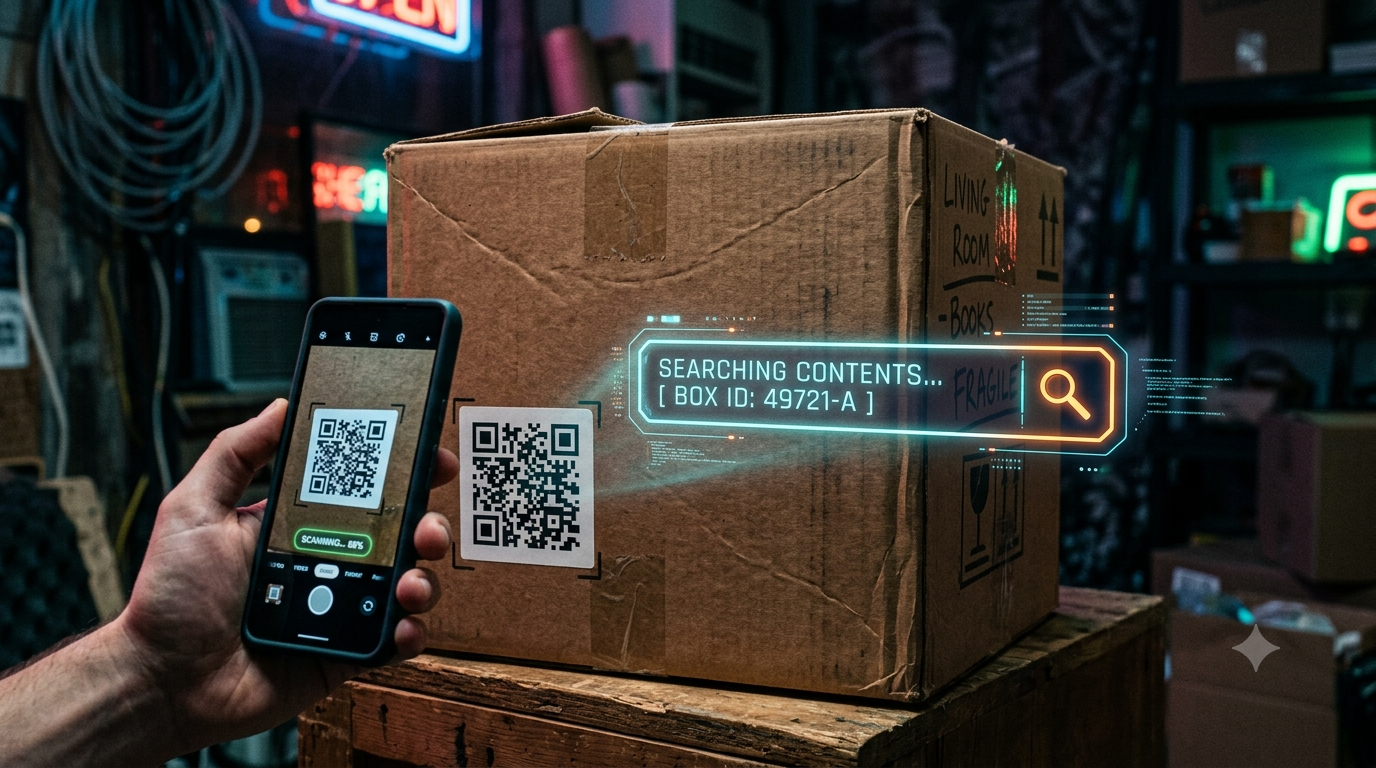
<p>I took this a step further with a Brother label printer, QR codes, plastic storage bins, and shelves.</p><p>My numbering system begins with “J”, so each box is numbered as “J001, J002…”, etc. The system only uses three digits. (If I need a fourth digit, I have a hoarding problem.)</p><p>Open the respective note in Obsidian, select the ellipse in the upper right corner of the note, then select <code>Copy Path &gt; as Obsidian URL</code>.</p><p>In the Brother P-Touch software (Mac, Windows) or Brother iPrint &amp; Label (iOS, Android), create a label that includes the number of the box along with a QR code. Paste the path that you just copied from Obsidian into the data field for the QR code and save it.</p><p>Print the label and stick it on the outside of the bin.</p><p>Now you have <strong>three ways</strong> to find a Thing.</p><ol>
<li>In Obsidian, search for a Thing. You’ll find out that it’s in bin 1234.</li>
<li>Find the number on the box and navigate to the Obsidian note named 1234 to see what’s in the bin.</li>
<li>Scan the QR code with your phone and the Obsidian note will open so you can see what’s in the bin.</li>
</ol>
<p>If you have multiple items - for example, power strips with different cord lengths - you can add photos to your notes so you know exactly which one is in the box.</p><h2 id="conclusion">Conclusion</h2>
<p>Getting organized like this removes cognitive load and the frustration of searching for something that you need, when you need it. What’s great about this system is that it’s practically free and rivals similar apps that you can find in the app stores. I stumbled on one with a subscription for $25/year!</p><p>Try it. You’ll be surprised how freeing it is to always being able to find a Thing.</p>
            ]]>
        </content>
    </entry>
    <entry>
        <title>CoTypist - Helpful Writing Assistant or Drunk Typing?</title>
        <author>
            <name>John A. Federico</name>
        </author>
        <link href="https://gadgetboy.org/cotypist-helpful-writing-assistant-or-drunk-typing/"/>
        <id>https://gadgetboy.org/cotypist-helpful-writing-assistant-or-drunk-typing/</id>
        <media:content url="https://gadgetboy.org/media/posts/97/cotypist_mac_keyboard.png" medium="image" />
            <category term="Software"/>
            <category term="Review"/>
            <category term="Productivity"/>
            <category term="Mac"/>
            <category term="AI"/>

        <updated>2026-04-24T06:48:14-05:00</updated>
            <summary type="html">
                <![CDATA[
                        <img src="https://gadgetboy.org/media/posts/97/cotypist_mac_keyboard.png" alt="" />
                    Imagine totally private AI autocomplete based on your writing style in every&hellip;
                ]]>
            </summary>
        <content type="html">
            <![CDATA[
                    <p><img src="https://gadgetboy.org/media/posts/97/cotypist_mac_keyboard.png" class="type:primaryImage" alt="" /></p>
                <p>Imagine <strong>totally private AI autocomplete</strong> based on your writing style in every application.  That’s CoTypist. </p><p>But I have feelings.</p><h2 id="what-is-cotypist-and-how-does-it-work">What is CoTypist and how does it work?</h2>
<p>From the developer:</p><blockquote>
<p>Cotypist <strong>predicts your next words</strong>, works in every app, and generates suggestions automatically. <strong>Save hours of typing</strong> every month.</p></blockquote>
<blockquote>
<p><strong>The Cotypist Way</strong></p><p>You never leave your flow.</p><p>You start typing, and the right words just appear—your words, the ones you would have written anyway.</p><p>No more wrestling to get the thoughts out of your head.</p><p>Tab. Smile. Keep going.</p><p><strong>What felt like work now feels like flying.</strong></p></blockquote>
<h2 id="how-it-works">How it works</h2>
<p><strong>Launch CoTypist.</strong> It runs a small LLM (Google Gemma 4 E2B) in the background using llama.cpp. (You can choose another model but this is the one that the developer recommends and installs during setup.)</p><p><strong>Start writing.</strong> CoTypist will periodically take screenshots of your screen to analyze your writing style. The screenshot never leaves your device as it’s all processed locally by Gemma 4. You’ll know its doing this because the icon is highlighted in the menu bar when it happens.</p><p>If you like the suggestions that it makes, you can simply hit the tab key to accept them and continue writing.</p><figure class="post__image"><img loading="lazy" src="https://gadgetboy.org/media/posts/97/cotypist_suggestion.png" alt="CoTypist Suggestion" width="1286" height="316" sizes="(min-width: 760px) 660px, calc(93.18vw - 30px)" srcset="https://gadgetboy.org/media/posts/97/responsive/cotypist_suggestion-xs.webp 320w ,https://gadgetboy.org/media/posts/97/responsive/cotypist_suggestion-sm.webp 480w ,https://gadgetboy.org/media/posts/97/responsive/cotypist_suggestion-md.webp 768w ,https://gadgetboy.org/media/posts/97/responsive/cotypist_suggestion-xl.webp 1024w"></figure><p>You don’t have to use the suggestions in every application - you can select which apps you want to use it with. For example, if you’re coding, you wouldn’t want to use CoTypist - such a small model is not going to perform well in that context.</p><p>When I first started writing with CoTypist, I thought, <em>“Go home, CoTypist. You’re drunk.”</em></p><p>But after about 30 minutes of use, it starts to learn. It will suggest words that you would have written anyway. (Usually.)</p><p>Sometimes, it takes a moment for CoTypist to realize that you’ve switched contexts. For example, I might write a business email and then move on to a personal one. For a moment or two, CoTypist will suggest words that are from the previous context. But after a few seconds, it realizes that this is a new context and will suggest words that  are more appropriate for the email I’m writing.</p><p><strong>It’s great for drafting.</strong> Sometimes you just can’t find the right words but CoTypist will suggest something that works - for now. Then you can go back and refine the language to your liking.</p><h2 id="quirks">Quirks</h2>
<p>Oddly, it doesn’t spell check. If I start typing a word incorrectly, it may recognize what word I’m <em>attempting</em> to type and already have a suggestion for the next word or phrase, so I’ll hit the tab key to accept it  - but it doesn’t correct the spelling of the previous word. That seems like an obvious miss.</p><p>I’ve also found that it tries to suggest extensions to words, even those that I’ve pasted. For example, I use Espanso for text snippets, such as a link I might send to someone to schedule a 30-minute call with me.</p><p>That particular URL ends with “/30m” but when I insert it with Espanso, CoTypist insists on adding “in” to the end of it (“/30min”). Of course, this breaks the scheduling link and I have to fight with CoTypist to get it to stop doing that.</p><p>CoTypist breaks web forms. If you’re like me and your workflow is keyboard-centric, you will tab your way through form fields. Using CoTypist, pressing the tab key will no longer advance to the next field - it will start suggesting words in a form field and the tab key accepts them. You will have to tell CoTypist to stay out of your browser or just rewire your brain. I’m hoping the developer finds a way to address this.</p><p>Otherwise, I’ve been using CoTypist for more than a week now and it’s been helpful. </p><h2 id="verdict">Verdict</h2>
<p> <a href="https://cotypist.app/">CoTypist</a> is currently free while in beta. Will I pay for it? Maybe. It will depend on the pricing and how much I value it in my workflow. There are only so many utilities that I’m willing to pay for, especially if there’s a subscription.</p><p>I’m also at a point where I need a Mac with more RAM - the 24 GB on my M2 MacBook Air is starting to get squeezed and having an LLM with its own instance of llama.cpp running in the background consumes too many resources.</p><p>Windows and Linux users are out of luck. Sorry.</p><p><em>This post was written with the help of CoTypist, natch.</em></p>
            ]]>
        </content>
    </entry>
    <entry>
        <title>I Gave an AI Agent Access to My CRM and Email. Here&#x27;s What Happened.</title>
        <author>
            <name>John A. Federico</name>
        </author>
        <link href="https://gadgetboy.org/i-gave-an-ai-agent-access-to-my-crm-and-email-heres-what-happened/"/>
        <id>https://gadgetboy.org/i-gave-an-ai-agent-access-to-my-crm-and-email-heres-what-happened/</id>
        <media:content url="https://gadgetboy.org/media/posts/96/hermes_crm_email.png" medium="image" />
            <category term="Startups"/>
            <category term="Productivity"/>
            <category term="Entrepreneurship"/>
            <category term="AI"/>

        <updated>2026-04-22T18:21:40-05:00</updated>
            <summary type="html">
                <![CDATA[
                        <img src="https://gadgetboy.org/media/posts/96/hermes_crm_email.png" alt="AI Agent controlling various systems" />
                    When I can’t find a warm connection to a suitable investor, I&hellip;
                ]]>
            </summary>
        <content type="html">
            <![CDATA[
                    <p><img src="https://gadgetboy.org/media/posts/96/hermes_crm_email.png" class="type:primaryImage" alt="AI Agent controlling various systems" /></p>
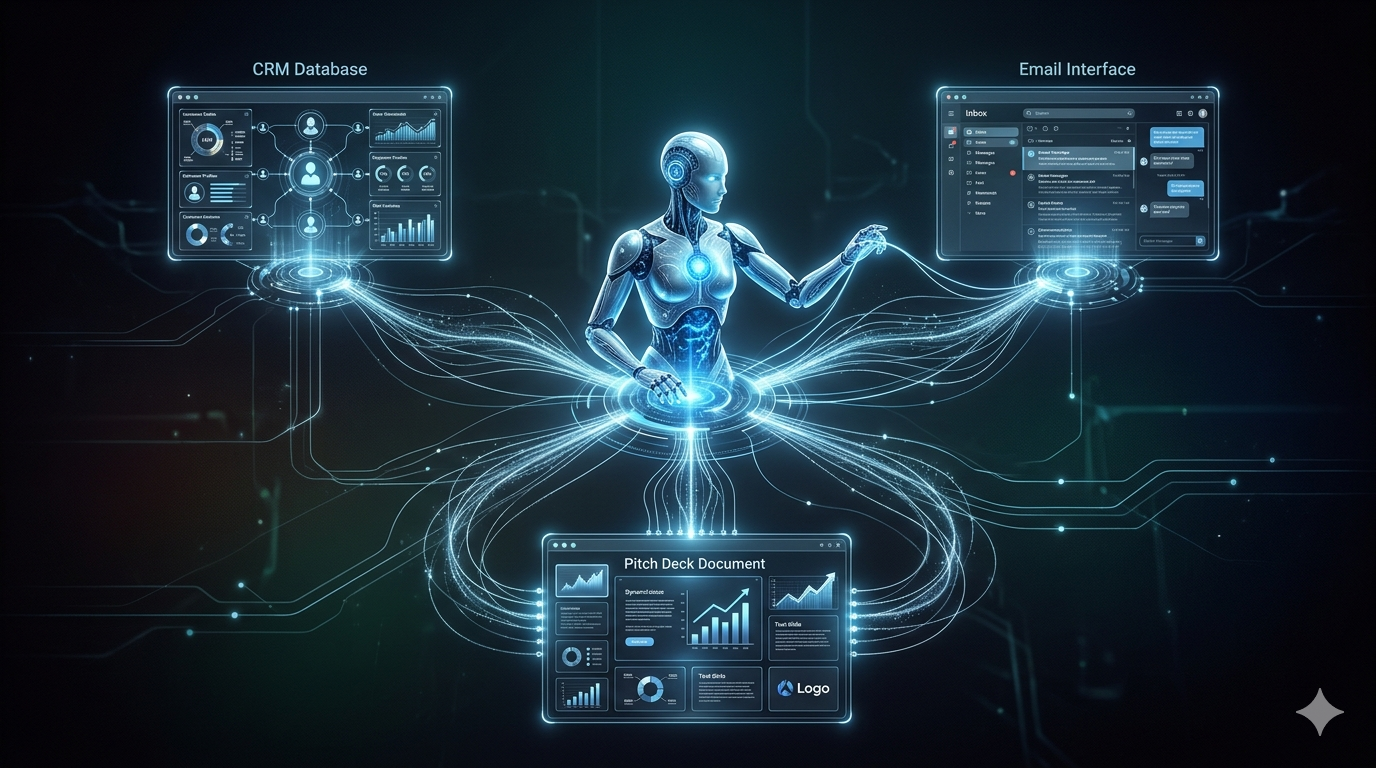
                <p>When I can’t find a warm connection to a suitable investor, I fall back on cold email - a personalized intro that explains why our <a href="https://evolvingedge.ai">company</a> might be a good fit, plus a link to a deck.</p><p>To make that process less painful, I vibe coded a simple application (just a set of scripts) called <strong>ScrappyDeck</strong>. It:</p><ul>
<li>Creates a unique tracking URL using a self-hosted instance of <a href="https://kutt.to/">Kutt</a> and a unique tracking token for each recipient</li>
<li>Logs interactions with the pitch deck in a self-hosted instance of <a href="http://openpanel.dev">OpenPanel.dev</a> so I can see whether they’ve viewed it and how engaged they are</li>
</ul>
<p>The name fits - it’s a scrappy combination of tools and scripts that gets the job done without paying DocSend $150/month for features I consider essential.</p><hr>
<h2 id="the-old-process">The Old Process</h2>
<p>Here’s what sending a single outreach email actually looked like:</p><ol>
<li>Research the firm and investor - usually done in a sprint, stored in my CRM (<a href="https://www.folk.app/">Folk</a>). This alone takes hours.</li>
<li>Enrich the data to make sure I have a current email address.</li>
<li>Write a general email explaining our business and the intent of the outreach.</li>
<li>Write a personalized intro explaining why we might be a fit, and attach a browser-only PDF link to the deck.</li>
<li>Send the email.</li>
<li>Log the interaction in Folk.</li>
<li>Move on to the next person.</li>
</ol>
<p>There’s real decision fatigue baked into this. Should I contact this investor at all? Is it actually a good fit? What’s the best way to connect our business to their thesis? And this is <em>after</em> I’ve already spent significant time vetting the firm based on public information.</p><p>It’s tedious AF.</p><p>I tried to simplify the process before. It was still a lot of copy-and-paste.</p><p>My goal was to get personalized outreach down from a few hours to a few minutes. It turns out I’ve finally pulled it off - using <strong><a href="https://hermes-agent.nousresearch.com/">Hermes</a></strong>.</p><hr>
<h2 id="enter-hermes">Enter Hermes</h2>
<p>Hermes is an open-source, self-hosted AI agent that works with whatever LLM you choose. Think of it as a capable assistant you can give access to your tools and then direct in plain language.</p><p>I spun up a Hermes instance in a Proxmox Linux container, running as root so it has full access to the file system and all resources. It’s isolated, so there’s not much it can break - though it does reach out to other systems via API.</p><p>Once I got comfortable with it, here’s what I connected:</p><ul>
<li><strong>ScrappyDeck</strong> — I worked with Claude Code to build a proper API so Hermes could generate tracking URLs and tokens on demand. Surprisingly easy.</li>
<li><strong>Folk</strong> — I handed Hermes the API endpoint, credentials, and docs. Within minutes it was reading and writing CRM records from plain language instructions.</li>
<li><strong>Brevo</strong> — Same story. SMTP credentials plus a plain text template, and it was sending email.</li>
</ul>
<hr>
<h2 id="the-workflow-i-built">The Workflow I Built</h2>
<p>Here are the exact instructions I gave Hermes:</p><blockquote>
<p>I have sometimes gathered multiple contacts from the same firm. It may sound counterintuitive, but we want to reach out to Associates or other people whose job it is to source deals first - they have greater incentive to get something into the pipeline.</p><p>Start with anyone holding that title or similar. If there’s no response after two follow-ups, move to the next person with that title. If no one like that exists, start reaching out to more senior people in alphabetical order. Senior titles are typically Partner, Managing Director, and Principal, or similar.</p><p>Based on that rule, select the next person from the Investors group in Folk in chronological order.</p><p>Research background information for the first line of the email. Write the intro.</p><p><strong>Present the first line to me for feedback or approval. DO NOT SEND WITHOUT MY APPROVAL.</strong></p><p>Once approved or edited, generate a unique deck link using the ScrappyDeck API.</p><p>Merge the firstName field, the intro line, and the deck link into the email template.</p><p>Send via Brevo.</p><p>Log the email as an Interaction on the person’s record in Folk.</p></blockquote>
<p>From there, we iterated. The agent asked me to clarify appropriate job titles. It also proposed a three-tiered seniority classification system, which I accepted. When it produced its first few introductory lines, I edited some of them so it could better calibrate to my voice.</p><p>After that? It executed flawlessly, one message at a time. It felt like magic.</p><hr>
<h2 id="the-one-hiccup">The One Hiccup</h2>
<p>After sending some messages, Hermes asked if I wanted to continue. I said, “Yes, we’ll send a total of 20 today.”</p><p>It sent eight more. Without showing them to me first. 😳</p><p>A few of them came out a bit wooden, and there was nothing I could do about it. Lesson learned.</p><p>I had it log that constraint to long-term memory and added an explicit rule: no batching, ever. One message at a time, every time.</p><hr>
<h2 id="the-verdict">The Verdict</h2>
<p>Setup took three hours. On the first day alone, it had already saved me that much time.</p><p>And since I have a virtually unlimited developer subscription to Kimi 2.5 Turbo for $7/week, there was zero incremental token cost.</p><p>I’ll take it.</p>
            ]]>
        </content>
    </entry>
    <entry>
        <title>The Data Center Debate Isn’t Binary</title>
        <author>
            <name>John A. Federico</name>
        </author>
        <link href="https://gadgetboy.org/the-data-center-debate-isnt-binary/"/>
        <id>https://gadgetboy.org/the-data-center-debate-isnt-binary/</id>
        <media:content url="https://gadgetboy.org/media/posts/94/the-data-center-debate-isnt-binary.png" medium="image" />
            <category term="Internet of Things"/>
            <category term="Innovation"/>
            <category term="Entrepreneurship"/>
            <category term="AI"/>

        <updated>2026-04-12T09:48:47-05:00</updated>
            <summary type="html">
                <![CDATA[
                        <img src="https://gadgetboy.org/media/posts/94/the-data-center-debate-isnt-binary.png" alt="The Data Center Debate Isn’t Binary - Distributed Computing is an Option" />
                    In Goodyear, Arizona, a suburb west of Phoenix, residents have spent the&hellip;
                ]]>
            </summary>
        <content type="html">
            <![CDATA[
                    <p><img src="https://gadgetboy.org/media/posts/94/the-data-center-debate-isnt-binary.png" class="type:primaryImage" alt="The Data Center Debate Isn’t Binary - Distributed Computing is an Option" /></p>
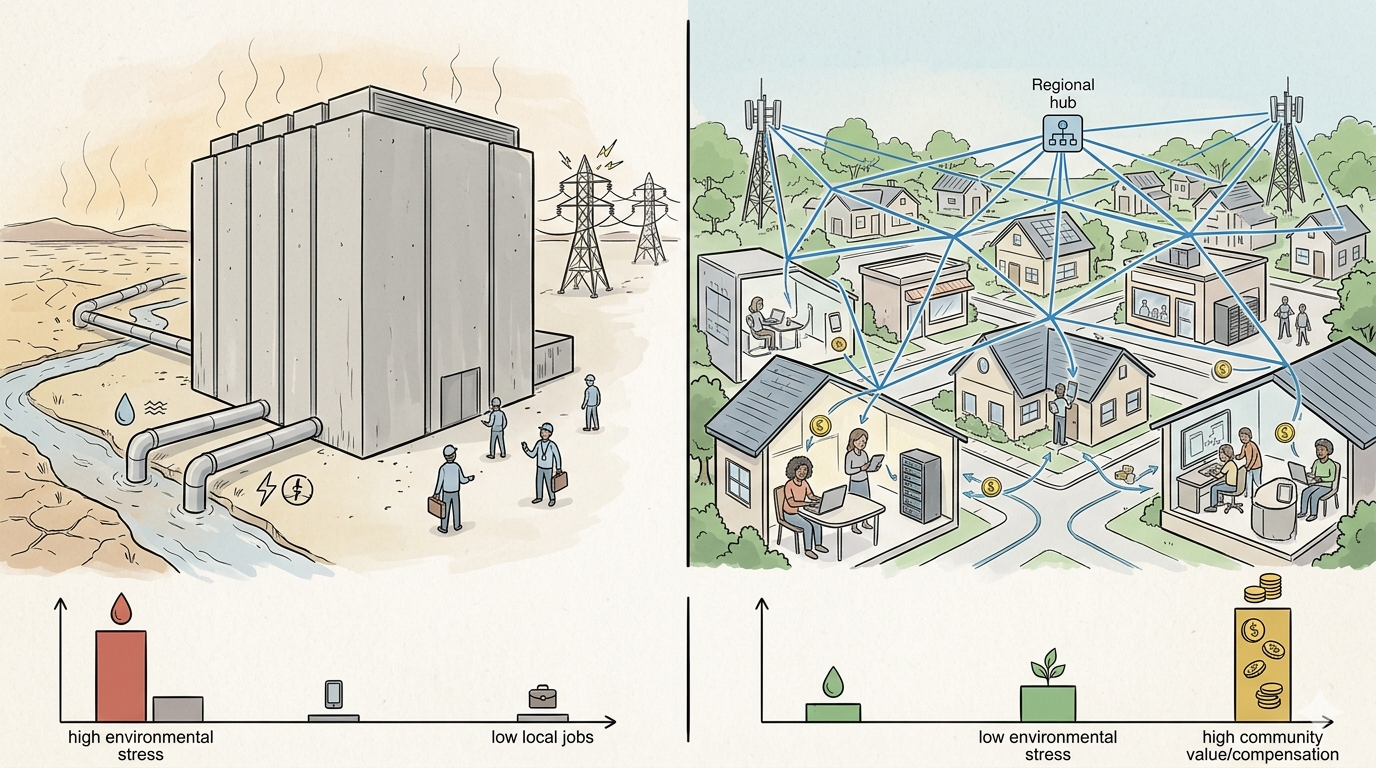
                <p>In Goodyear, Arizona, a suburb west of Phoenix, residents have spent the last two years watching data centers multiply along the I-10 corridor. The facilities are enormous — windowless, humming structures that consume water and power at a scale that strains comprehension. Local officials approved them with the promise of jobs and tax revenue. The construction crews came and went. The permanent workforces never materialized at the scale implied. What remained were the facilities themselves — drawing on the same aquifers the community depends on, consuming power that pushes the regional grid during summer heat events, and generating a fraction of the lasting economic activity the approvals were sold on. Goodyear is not exceptional. It is representative.</p>
<p>On March 25, 2026, Senators Bernie Sanders and Edward Markey, along with Representative Alexandria Ocasio-Cortez, introduced legislation to impose a moratorium on the construction of new data centers in the United States. The bill was met, predictably, with alarm from the technology industry and dismissal from those who view any constraint on AI development as economically reckless. It was met, equally predictably, with enthusiasm from environmental advocates who have watched data center construction accelerate across American communities with consequences that are difficult to ignore.</p>
<p>That federal bill has not moved since. It sits in committee, unlikely to advance in this Congress. But the debate it opened has migrated to the states, and nowhere more sharply than New York. In June, the state legislature passed the Responsible Data Center Development Act, a one-year moratorium on new permits for large facilities. Governor Kathy Hochul has not signed it. Instead, in July, she issued a narrower executive order pausing certain approvals while state agencies study the industry's impact — a hedge, not a resolution. She now has until December 31 to sign the legislature's bill, veto it, or let it lapse. The same question Sanders, Markey, and Ocasio-Cortez put in front of Congress in March is now sitting on a single governor's desk, with a deadline attached.</p>
<p>Those consequences are not abstractions. A single modern AI data center consumes as much electricity as 100,000 average American households. The largest facilities currently under development will consume twenty times more <sup><a id="ffn1" href="#fn1" class="footnote">1</a></sup>. In 2025, North American data centers drew nearly one trillion liters of water for cooling<sup><a id="ffn2" href="#fn2" class="footnote">2</a></sup> — water pulled from the same rivers, aquifers, and municipal systems that the surrounding communities depend on. In the Phoenix metropolitan area alone, data centers consume an estimated 385 million gallons of water annually<sup><a id="ffn3" href="#fn3" class="footnote">3</a></sup>. These are not the externalities of a mature, stable industry absorbing the costs of its own growth. They are the externalities of an industry expanding at a pace that local infrastructure, local water supplies, and local communities were not designed to absorb.</p>
<p>The frustration animating the Sanders-Markey-Ocasio-Cortez bill is legitimate. The communities bearing these costs did not choose to host the infrastructure of the AI economy. They did not negotiate the terms. They were not meaningfully compensated. And in most cases, the economic benefits the industry promised — jobs, tax revenue, local investment — have arrived in forms far narrower than advertised. The permanent workforce of a modern hyperscale data center is remarkably small relative to its physical and environmental footprint. The construction jobs are temporary. The tax arrangements are frequently the result of incentives that reduce rather than increase the public benefit.</p>
<p>But the moratorium debate, as it is currently being conducted, rests on an assumption that has not been examined: that centralized data centers are the only architecture capable of delivering the compute that AI requires. That assumption is not a technical fact. It is not an engineering constraint. It is an architectural habit — one the industry has a powerful financial interest in preserving, and one that the policy conversation has not yet thought to question.</p>
<p>The question worth asking is not only whether we should build fewer data centers. It is whether we need to build them at all.</p>
<p>The moratorium debate has settled into a familiar shape. On one side, the technology industry argues that data centers are the unavoidable infrastructure of economic competitiveness — that any constraint on their construction is a constraint on American innovation. On the other, a growing coalition of environmental advocates, community organizations, and now members of Congress argues that the costs being imposed on communities and ecosystems are no longer acceptable. Both sides are arguing, with considerable energy, about how much of the same thing to build.</p>
<p>Neither side has much incentive to ask whether the thing itself is necessary.</p>
<p>The technology industry has spent decades and hundreds of billions of dollars building centralized infrastructure. Questioning its necessity is not a conversation its incumbents are structured to have. The moratorium advocates need the threat to remain total — a partial threat produces partial urgency. And the policy apparatus that mediates between them operates almost entirely without technical staff who understand what the current architecture of the internet already makes possible.</p>
<p>The result is a debate conducted in good faith about the wrong question. The right question is not how many data centers to build. It is whether the compute the AI economy requires can be delivered in a fundamentally different way — one that distributes the infrastructure, distributes the cost, and distributes the benefit. The answer, as the last two decades of computing history make clear, is yes. The policy conversation simply hasn't looked there yet.</p>
<p><strong>The Architecture Already Exists. The Policy Conversation Just Hasn't Found It Yet.</strong></p>
<p>In 1999, researchers at UC Berkeley launched SETI@home. The premise was straightforward and, at the time, quietly radical: rather than building a supercomputer to analyze radio telescope data, they would use computers that already existed — in homes, offices, and university labs — donating their idle processing cycles to a shared scientific purpose. Over two decades, more than 5.2 million participants contributed their hardware to a production-grade scientific computing network that delivered results no centralized facility could have matched at comparable cost<sup><a id="ffn4" href="#fn4" class="footnote">4</a></sup>. The model worked. It worked at scale. And it worked on consumer-grade residential hardware.</p>
<p>SETI@home was not an anomaly. It was a proof of concept that the research community immediately recognized and extended. Folding@home, launched out of Stanford University, applied the same architecture to simulating the molecular behavior underlying diseases including Alzheimer's, cancer, and Parkinson's. When COVID-19 struck in 2020, hundreds of thousands of volunteers activated their home computers and gaming rigs. The result was historically unprecedented: Folding@home became the first computing system to break the exascale barrier, reaching a peer-reviewed peak performance of 1.01 exaFLOPS — more raw compute power than the world's most powerful supercomputers at the time — achieved entirely through the aggregated processing of volunteer residential and institutional hardware<sup><a id="ffn5" href="#fn5" class="footnote">5</a></sup>. It did not require a single new data center.</p>
<p>To understand the scale at stake, consider a rough order of magnitude. The United States has approximately 330 million smartphones, 270 million personal computers, and tens of millions of additional connected devices in homes and small businesses — the overwhelming majority sitting idle for 16 or more hours each day, 92% of which are connected by a broadband internet connection<sup><a id="ffn6" href="#fn6" class="footnote">6</a></sup>. Folding@home, at its COVID-19 peak, aggregated roughly 4.8 million CPU cores and 280,000 GPUs from volunteer devices to achieve exascale performance. The installed base of idle consumer hardware in the United States is orders of magnitude larger. The compute is not missing nor disconnected. It is simply unorganized, uncompensated, and invisible to the policy conversation debating whether to build more of what we already have in abundance.</p>
<p>The workloads most suited to this architecture are not frontier model training — which genuinely requires specialized hardware at scale — but inference, content delivery, and edge processing: the tasks that account for the vast majority of data center capacity currently being built and the environmental costs being debated.</p>
<p>These are not consumer experiments. They are peer-reviewed, formally documented scientific computing networks that vindicated a fundamental architectural principle: computation distributed across geographically dispersed hardware, coordinated by a central orchestration layer, can outperform centralized infrastructure at a fraction of the cost.</p>
<p>The commercial world has reached the same conclusion, though not yet at the residential layer. The internet's largest delivery platforms — Cloudflare, Akamai, Fastly — are all built on the premise that compute should happen closer to where it is needed. Their networks span hundreds of cities, distributing workloads regionally rather than serving the entire country from a handful of mega-facilities. The direction is unambiguous: the industry has been moving away from centralization for two decades. What those platforms have not yet done is extend that logic to its natural conclusion — past the regional data center and into the neighborhoods, homes, and small businesses where the hardware already exists and sits largely idle.</p>
<p>A new category of participant-owned infrastructure has emerged to test exactly this model commercially — networks that aggregate hardware in homes and businesses, coordinating idle capacity to serve real workloads outside of traditional data center facilities. The concept has attracted substantial capital: the sector raised over $1 billion in private investment in 2025 alone and has deployed tens of millions of active devices globally<sup><a id="ffn7" href="#fn7" class="footnote">7</a></sup>.</p>
<p>The category has not been without problems. Some networks in this space built their economic models on cryptocurrency tokens rather than straightforward cash compensation — and when token values collapsed, so did participant incentives, network coverage, and in some cases, the underlying business.<sup><a id="ffn8" href="#fn8" class="footnote">8</a></sup> These failures are real, and the skepticism they generated is earned.</p>
<p>But the failure of a token-based incentive model does not invalidate the underlying architectural principle — any more than the failure of early dot-com companies invalidated the internet. The token-based incentive structure was not inherent to the architecture. It was a design choice. And design choices can be changed. The more fundamental question for policymakers is not which specific network gets there first, but whether the architectural model — community-owned, residentially-distributed compute, compensated in straightforward cash rather than speculation — is viable. The scientific computing precedent suggests it is. The economic logic suggests it should be. Whether it can be delivered at commercial scale is the infrastructure challenge this moment demands.</p>
<p>That distinction — between community-owned infrastructure built on transparent cash economics and the speculative token networks that preceded it — is precisely the one the policy conversation has not yet made. It matters, because the model that serves the public interest is not the one that collapsed. It's the one being built on its lessons.</p>
<p>Meanwhile, at the device level, the architecture has moved further still. IBM's own technical documentation defines edge computing for IoT as "the practice of processing and analyzing data closer to the devices that collect it rather than transporting it to a data center first."<sup><a id="ffn9" href="#fn9" class="footnote">9</a></sup> The company projects that 75% of enterprise data will be processed at the edge — compared to only 10% previously<sup><a id="ffn10" href="#fn10" class="footnote">10</a></sup>. In manufacturing, retail, healthcare, and transportation, STL Partners' 2025 research describes the edge computing market as having reached a "tipping point" for how industry stakeholders think about deployment, AI workloads, and infrastructure models. The shift is not emerging. It has already arrived.</p>
<p>The pattern is consistent across every layer of the stack — from volunteer scientific computing to commercial delivery networks to IoT device architecture: the industry has been systematically discovering that distributing compute closer to where it is needed produces better outcomes at lower cost, with less environmental concentration. The question the current policy debate has not yet asked is the obvious one: if compute can be distributed to 330 cities, to thousands of network hotspots, to the factory floor and the retail shelf — why are we still building it as if the only option is a new facility consuming the water supply of a mid-sized American city?</p>
<p>The distributed computing model is not a future possibility. It is a present reality operating across multiple industries and infrastructure categories simultaneously. The data center debate has simply not looked there yet.</p>
<p>There is a standard story told about data centers and the communities that host them. The story goes like this: a technology company selects a site, negotiates with local officials, breaks ground on a facility that will power the digital economy, and in return delivers jobs, tax revenue, and economic vitality to a community that might otherwise be struggling to attract investment. It is a story the industry tells fluently, and it is a story that local and state officials have been eager to believe.</p>
<p>The evidence, accumulated now across hundreds of communities and dozens of independent analyses, tells a different story.</p>
<p>The jobs are real — but they are not what was advertised. A large-scale data center creates between 1,000 and 1,500 construction positions during the build phase — well-paying work for electricians, ironworkers, and building trades that typically lasts 18 to 24 months before it ends. The permanent operational workforce that follows is, by any honest accounting, remarkably small: typically between 50 and 200 full-time employees for a facility consuming as much power as a small city. Brookings Institution analysis describes the standard data center development model as one that delivers "short-term construction jobs and revenue, but little durable local economic upside."<sup><a id="ffn11" href="#fn11" class="footnote">11</a></sup> A January 2026 report from Food &amp; Water Watch found Microsoft announcing $3.3 billion in data center investment paired with 800 permanent jobs — while simultaneously cutting 7,500 positions elsewhere<sup><a id="ffn12" href="#fn12" class="footnote">12</a></sup>. NPR's reporting on data center expansion found the same pattern repeated across the country: record-setting price tags, communities wooed with promises, and permanent workforces that never materialized at the scale implied<sup><a id="ffn13" href="#fn13" class="footnote">13</a></sup><sup><a id="ffn14" href="#fn14" class="footnote">14</a></sup>. Good Jobs First concluded that data centers "can replace as many jobs as they create" when accounting for the energy and infrastructure they consume that might otherwise support more labor-intensive industries <sup><a id="ffn15" href="#fn15" class="footnote">15</a></sup>.</p>
<p>For the family living two miles from a hyperscale facility, the distinction between 1,500 construction jobs that lasted eighteen months and a permanent workforce of 200 is not a policy abstraction. It is the difference between a promise kept and a promise broken.</p>
<p>The tax revenue story is similarly complicated. At least 36 states now offer targeted tax incentives for data center development — exemptions, credits, and abatements designed to attract facilities to their jurisdictions. Good Jobs First examined these programs and found that of the 32 states offering tax incentives, 12 don't even disclose the aggregate revenue losses the programs produce. CNBC reported in June 2025 that states are forfeiting hundreds of millions of dollars in tax revenue to technology companies — with one state's own analysis classifying its data center exemption as a "moderate economic benefit" that "does not pay for itself."<sup><a id="ffn16" href="#fn16" class="footnote">16</a></sup> Indiana's Citizens Action Coalition estimated the state's sales tax exemption could cost tens of billions of dollars over 50 years — and noted the state had never produced an estimate of the figure.<sup><a id="ffn17" href="#fn17" class="footnote">17</a></sup> "We know of no other form of state spending that is so out of control," Good Jobs First wrote. States are, in other words, competing to subsidize some of the most profitable corporations on earth in exchange for facilities that consume their water, strain their grids, and employ a fraction of the workforce the investment implied.</p>
<p>The communities that bear the costs most directly are not the ones negotiating the terms. The Lincoln Institute of Land Policy has documented how communities across the United States are wooing data centers with tax breaks and incentives while being entirely unprepared for the demands those facilities place on land, water, and power infrastructure<sup><a id="ffn18" href="#fn18" class="footnote">18</a></sup>. In Texas, where the data center boom has concentrated with particular intensity, AI data centers are consuming 49 billion gallons of water<sup><a id="ffn19" href="#fn19" class="footnote">19</a></sup> while residents in drought-affected areas are asked to cut back on showers. Approximately 1,260 data centers in the United States are located in or adjacent to disadvantaged communities — communities that absorb the environmental footprint while the economic benefits flow primarily to corporate balance sheets and their shareholders<sup><a id="ffn20" href="#fn20" class="footnote">20</a></sup>.</p>
<p>This is not an argument against economic development. It is an argument about what economic development actually looks like when the infrastructure model is examined honestly. The relevant comparison is not between data centers and nothing. It is between a model that concentrates infrastructure ownership in a small number of corporate hands — extracting value from communities while offering them temporary construction work and opaque tax arrangements — and a model that distributes both the infrastructure and the economic return to the people who host it.</p>
<p>The rooftop solar analogy is instructive here. For decades, energy generation in the United States operated on the same centralized logic as data centers: large utilities owned the generation infrastructure, ratepayers consumed the output, and the economic benefit of the asset flowed to the corporation. Distributed solar changed that logic. When households and small businesses became energy producers — contributing power back to the grid and receiving compensation for what they generated — the economic relationship between infrastructure and community was fundamentally restructured. <sup><a id="ffn21" href="#fn21" class="footnote">21</a></sup> The hardware investment was made by individuals. The return flowed to individuals. The grid became more resilient because the generation was distributed. The Department of Energy's research on distributed solar documents this dynamic directly: distributed generation reduces the infrastructure investments utilities must make while simultaneously building community wealth. The infrastructure cost is already sunk. The resource — sunlight, idle processing capacity — is underutilized. And the economic upside, which has historically flowed to centralized operators, can instead flow to individuals.</p>
<p>The data center debate has not yet asked whether the same restructuring is possible for compute. It should.</p>
<p>The moratorium debate, as it currently stands, is asking one question: how many new data centers should be built. That is a reasonable question. It is not the right question — or at least not the complete one. The more consequential questions have not yet entered the policy conversation, and they will not unless policymakers, advocates, and the public begin demanding they be asked.</p>
<p>The first question is one of transparency. Congress has already recognized that the data center industry operates with a remarkable degree of opacity about its own impact. The Data Center Transparency Act<sup><a id="ffn22" href="#fn22" class="footnote">22</a></sup>, introduced in December 2025, would require the EPA to report on data centers' effects on air quality, water consumption, and pollution discharge — and require the Energy Information Administration to collect and publish electricity consumption data for every data center in the United States. Senator Dick Durbin's companion Data Center Water and Energy Transparency Act<sup><a id="ffn23" href="#fn23" class="footnote">23</a></sup>, introduced March 25, 2026, goes further: requiring data center operators to disclose both current and projected energy and water consumption to the states where they operate. These bills have not yet passed. They should. A policy debate about an industry whose environmental footprint is not publicly tracked in any systematic way is a debate conducted without its most basic inputs. Before Congress can responsibly evaluate a moratorium, it needs the data the moratorium's proponents are rightly demanding be made visible.</p>
<p>The second question is one of alternatives assessment. The legislative and regulatory apparatus that evaluates infrastructure development in the United States is well designed to ask: should this facility be built, and under what conditions? It is almost entirely unprepared to ask: does this facility need to exist in this form? Environmental impact assessments for data centers focus on the project as proposed — the footprint, the water draw, the grid connection — not on whether the compute capacity the project provides could be delivered through a different architectural model. That gap is not a technical limitation. It is a policy choice. Requiring that major data center projects include a distributed alternatives assessment — a structured analysis of whether the compute capacity could be delivered through distributed or edge architectures — would not block development. It would ensure that the approval of centralized infrastructure reflects an informed decision, not a default.</p>
<p>The third question is one of ownership. Across the United States, communities are being asked to host compute infrastructure they do not own, do not control, and from which they derive limited lasting benefit. The policy imagination here has barely begun to develop — but it is developing. Municipalities, cooperatives, and community organizations are beginning to ask whether the infrastructure that powers the digital economy can be owned by the communities it serves rather than by the corporations that extract value from them. Federal and state incentive structures that currently flow almost exclusively to corporate data center operators could, with deliberate policy design, support community-owned distributed infrastructure instead. The fiscal tools exist. The rooftop solar cooperative model — in which community members collectively own generation assets and share the returns — provides the organizational precedent. The policy will to apply it to compute infrastructure does not yet exist. It should.</p>
<p>These are not radical proposals. They are the natural extension of the same values that animate the moratorium debate itself — that the public interest should shape how compute infrastructure is built, where it is sited, who bears its costs, and who captures its benefits. A moratorium conducted without these questions on the table is an incomplete response to a legitimate problem. A policy conversation that incorporates them is one that might actually produce something durable.</p>
<p>There is a version of this story that ends with a moratorium — with Congress drawing a line around the data center model that has extracted water, strained grids, and made hollow promises to communities across the country. That outcome would be understandable. The frustration that produced it is legitimate.</p>
<p>That choice is no longer hypothetical. In New York, it is sitting on a governor's desk right now. Kathy Hochul has until December 31 to decide whether the Responsible Data Center Development Act becomes law — whether her state joins the ranks of jurisdictions that chose the pause over the harder work of building something different. Whatever she decides will not resolve the underlying question. A signature enacts a moratorium. It does not, by itself, build a single distributed node, cooperative, or community-owned alternative. That work remains undone regardless of which way the deadline breaks — in New York and in every state weighing the same choice behind it.</p>
<p>But a moratorium is a pause, not a solution. And the more urgent work is not stopping something. It is building something different — infrastructure that is distributed by design, owned by the communities it serves, and compensated in the plain economic language of dollars rather than promises.</p>
<p>The policy imagination this moment requires is not central planning. It is the opposite: creating the conditions under which distributed innovation can happen at scale — in garages, in home offices, in the small businesses that line the main streets of every community currently being asked to host a hyperscale facility instead. The history of American infrastructure is, at its best, a history of distributed ownership: rural electric cooperatives, community banks, rooftop solar. The compute infrastructure of the AI economy does not have to be an exception to that history. It can be its next chapter.</p>
<p>The compute the AI economy requires does not need to come from the next facility built over someone's aquifer. The hardware to deliver it already exists in the neighborhoods that have been asked to absorb the costs of an infrastructure model they never chose and do not own. The architecture to coordinate it is proven. The economic logic to sustain it is sound.</p>
<p>What remains is the policy imagination to see it.</p>
<p><em>John Federico is a strategist and entrepreneur who has spent 30 years translating emerging technologies into practical products. He runs IT infrastructure systems at home at meaningful scale and is the founder of Evolving Edge, a distributed edge computing company.</em></p>
<p><em>This piece was researched and written with AI assistance. All arguments, editorial decisions, and factual verifications are the author's own.</em></p>
<ol id="footnotes">
<li id="fn1"><a href="https://iea.blob.core.windows.net/assets/de9dea13-b07d-42c5-a398-d1b3ae17d866/EnergyandAI.pdf">Energy and AI Report, International Energy Association, April 2025</a> <a href="#ffn1">↩︎</a></li>
<li id="fn2"><a href="https://www.mordorintelligence.com/industry-reports/north-america-data-center-water-consumption-market">North America Data Center Water Consumption Market Size &amp; Share Analysis - Growth Trends and Forecast (2025 - 2030), Mordor Intelligence</a> <a href="#ffn2">↩︎</a></li>
<li id="fn3"><a href="https://www.ceres.org/resources/reports/drained-by-data-the-cumulative-impact-of-data-centers-on-regional-water-stress">Drained by Data: The Cumulative Impact of Data Centers on Regional Water Stress, Ceres, September 2025</a> <a href="#ffn3">↩︎</a></li>
<li id="fn4"><a href="https://setiathome.berkeley.edu/sah_papers/cacm.php">SETI@home: An Experiment in Public-Resource Computing, November 2022</a> <a href="#ffn4">↩︎</a></li>
<li id="fn5"><a href="[https://www.nature.com/articles/s41557-021-00707-0](https://www.nature.com/articles/s41557-021-00707-0)">SARS-CoV-2 simulations go exascale to predict dramatic spike opening and cryptic pockets across the proteome, Nature Chemistry, May 2021</a> <a href="#ffn5">↩︎</a></li>
<li id="fn6"><a href="https://www.parksassociates.com/blogs/press-releases/ninety-two-percent-of-us-households-now-have-broadband-at-home-according-to-parks-associates">Ninety-two percent of US households now have broadband at home, Parks Associates, 2024</a> <a href="#ffn6">↩︎</a></li>
<li id="fn7"><a href="https://messari.io/report-pdf/d8769d123e144d9ebdc624034ae203426050e0a8.pdf">State of DePIN 2025, Messari, January 2025</a> <a href="#ffn7">↩︎</a></li>
<li id="fn8"><a href="https://chainscorelabs.com/blog/depin-building-physical-infra-on-chain/depin-tokenomics-and-incentives/the-cost-of-building-a-depin-without-a-clear-exit-liquidity-plan">The Cost of Building a DePIN Without a Clear Exit Liquidity Plan, Prasad Kumkar, Chainscore Labs</a> <a href="#ffn8">↩︎</a></li>
<li id="fn9"><a href="https://www.ibm.com/think/topics/iot-edge-computing">Edge Computing for IoT, IBM</a> <a href="#ffn9">↩︎</a></li>
<li id="fn10"><a href="https://www.ibm.com/solutions/edge-computing">Edge Computing Solutions, IBM</a> <a href="#ffn10">↩︎</a></li>
<li id="fn11"><a href="https://www.brookings.edu/articles/turning-the-data-center-boom-into-long-term-local-prosperity/">Turning the data center boom into long-term, local prosperity, February 2026</a> <a href="#ffn11">↩︎</a></li>
<li id="fn12"><a href="https://www.foodandwaterwatch.org/wp-content/uploads/2026/03/RPT2_2602_DataCenterMoratorium.pdf">The Urgent Case Against Data Centers, Food and Water Watch, March 2026</a> <a href="#ffn12">↩︎</a></li>
<li id="fn13"><a href="https://www.npr.org/2025/04/02/1242229718/ai-mississippi-jobs-data-centers-virginia">What $10 billion in data centers actually gets you, April 2025</a> <a href="#ffn13">↩︎</a></li>
<li id="fn14"><a href="https://www.npr.org/2025/04/10/nx-s1-5355017/data-centers-bring-money-to-small-towns-but-do-they-also-bring-jobs">Data centers bring money to small towns. But do they also bring jobs?, April 2025</a> <a href="#ffn14">↩︎</a></li>
<li id="fn15"><a href="https://goodjobsfirst.org/cloudy-data-costly-deals-how-poorly-states-disclose-data-center-subsidies/">Cloudy Data, Costly Deals: How Poorly States Disclose Data Center Subsidies, Good Jobs First</a> <a href="#ffn15">↩︎</a></li>
<li id="fn16"><a href="https://www.cnbc.com/2025/06/20/tax-breaks-for-tech-giants-data-centers-mean-less-income-for-states.html">In race to attract data centers, states can forfeit hundreds of millions of dollars in tax revenue to tech companies</a> <a href="#ffn16">↩︎</a></li>
<li id="fn17"><a href="https://www.citact.org/sites/default/files/CAC-Data-Center-Webinar-Slides-01-27-2024-1.pdf">The Hidden Costs of Data Centers, Citizens Action Coalition, January 2024</a> <a href="#ffn17">↩︎</a></li>
<li id="fn18"><a href="https://www.lincolninst.edu/publications/land-lines-magazine/articles/land-water-impacts-data-centers/">Data Drain: The Land and Water Impacts of the AI Boom, October 2025</a> <a href="#ffn18">↩︎</a></li>
<li id="fn19"><a href="https://www.sacurrent.com/news/san-antonio-data-centers-guzzled-463-million-gallons-of-water-as-area-faced-drought-38116670/">San Antonio data centers guzzled 463 million gallons of water as area faced drought , July 2025</a> <a href="#ffn19">↩︎</a></li>
<li id="fn20"><a href="[https://ace-usa.org/blog/research/research-environmental-policy/the-debate-on-data-center-development-costs-benefits-and-community-responses/](https://ace-usa.org/blog/research/research-environmental-policy/the-debate-on-data-center-development-costs-benefits-and-community-responses/)">The Debate On Data Center Development: Costs, Benefits, and Community Responses, ACE, April 2026</a> <a href="#ffn20">↩︎</a></li>
<li id="fn21"><a href="https://www.energy.gov/sites/default/files/2024-11/CEF%20Solar%20Economic%20Development%20Report%2C%20DoE%2C%20FINAL.pdf">Deriving Community Economic Development through Distributed Solar, Department of Energy, November 2024</a> <a href="#ffn21">↩︎</a></li>
<li id="fn22"><a href="https://www.congress.gov/bill/119th-congress/house-bill/6984/text">H.R.6984 - Data Center Transparency Act, Rep. Robert Menendez</a> <a href="#ffn22">↩︎</a></li>
<li id="fn23"><a href="https://www.durbin.senate.gov/newsroom/press-releases/as-utility-costs-rise-durbin-introduces-new-legislation-to-bring-transparency-to-energy-and-water-consumption-by-data-centers">Data Center Water and Energy Transparency Act, March 2026</a> <a href="#ffn23">↩︎</a></li>
<li id="fn24"><a href="[https://www.ntari.org/post/louisville-community-data-center-cooperative-feasibility-study](https://www.ntari.org/post/louisville-community-data-center-cooperative-feasibility-study)">Louisville Community Data Center Cooperative Feasibility Study, Network Theory Applied Research Institute, November 2025</a> <a href="#ffn24">↩︎</a></li>
</ol>
            ]]>
        </content>
    </entry>
    <entry>
        <title>How X.com Builds the &quot;For You&quot; Feed</title>
        <author>
            <name>John A. Federico</name>
        </author>
        <link href="https://gadgetboy.org/how-xcom-builds-the-for-you-feed/"/>
        <id>https://gadgetboy.org/how-xcom-builds-the-for-you-feed/</id>
        <media:content url="https://gadgetboy.org/media/posts/93/x_algorithm_for_muggles.png" medium="image" />
            <category term="Marketing"/>
            <category term="Explainer"/>
            <category term="AI"/>

        <updated>2026-02-02T09:12:57-06:00</updated>
            <summary type="html">
                <![CDATA[
                        <img src="https://gadgetboy.org/media/posts/93/x_algorithm_for_muggles.png" alt="The X Algorithm for Muggles and MudBloods" />
                    X.com/Twitter* made public their algorithms for how content is presented to you.
                ]]>
            </summary>
        <content type="html">
            <![CDATA[
                    <p><img src="https://gadgetboy.org/media/posts/93/x_algorithm_for_muggles.png" class="type:primaryImage" alt="The X Algorithm for Muggles and MudBloods" /></p>
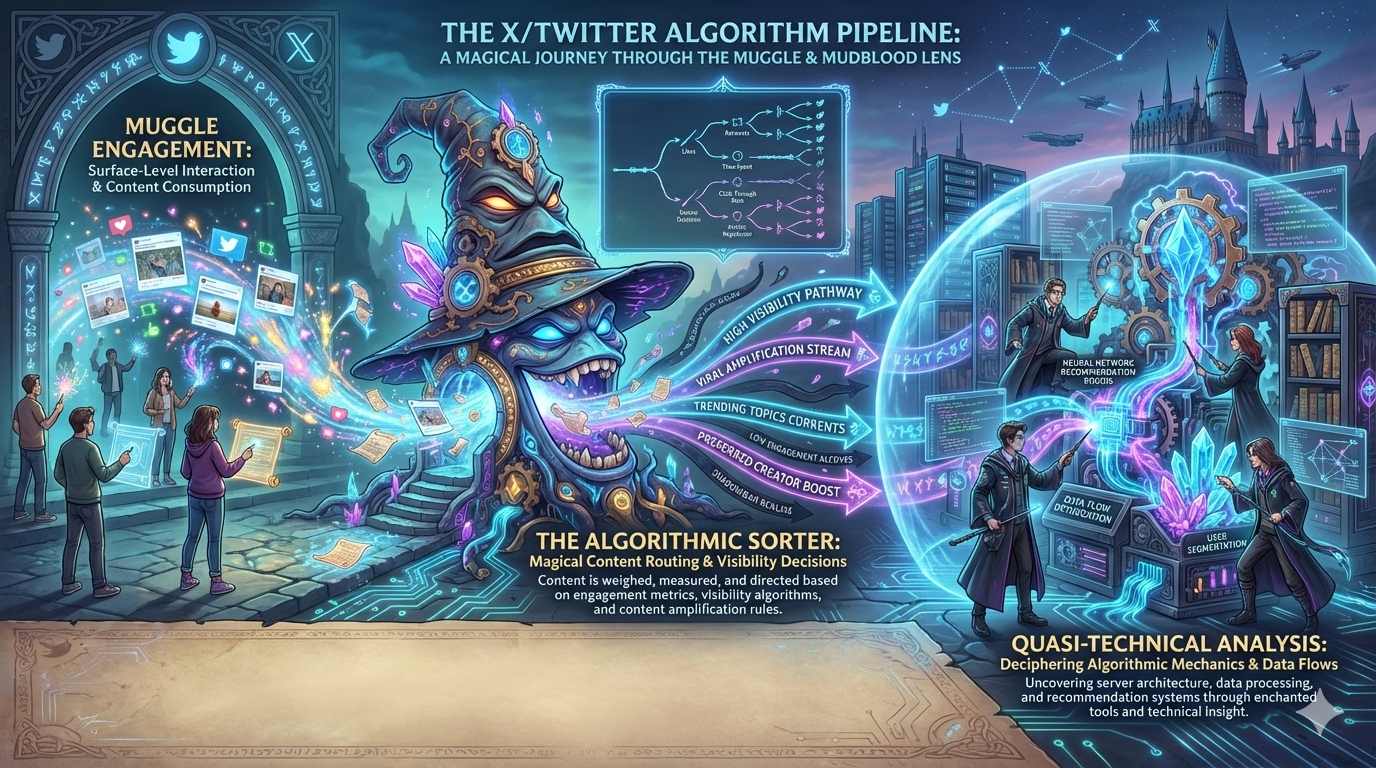
                <p>X.com/Twitter* made public their algorithms for how content is presented to you. Just like LinkedIn, there isn’t just a single algorithm - it’s a multi-algorithm pipeline that helps determine what you see.</p><p>I take all of this with a bit of skepticism since Elon is nearly always in my <em>“For You”</em> feed no matter what I do, but if you’re interested in how this works and how it potentially affects you, read on.</p><p>Thanks to <a href="https://codepointer.substack.com/p/x-algorithm-how-x-decides-what-550">Yongkyun</a> (or Daniel) for his breakdown of the architecture. Without it, I almost certainly wouldn’t have been able to parse the original code to understand how this works. </p><p>This is basically his breakdown, rewritten for Muggles™ and Mudbloods™.</p><h3 id="1-its-an-ai-powered-recommendation-pipeline-natch">1) It’s an AI-powered recommendation pipeline, natch</h3>
<p>Unlike the early days of Twitter, your feed isn’t just a simple chronological list anymore - it’s a <strong>multi-stage machine-learning system</strong> that processes millions of tweets whenever you open your <em>For You</em> timeline. The processing pipeline has clear stages that transform tweets into a personalized feed. (Or slop, depending on your perspective.)</p><h3 id="2-there-are-two-main-sources-of-content-for-candidate-tweets">2) There are two main sources of content for “candidate” tweets</h3>
<p>When you load the feed, X gathers a pool of potential tweets to show you from two places:</p><ul>
<li><strong>In-network tweets:</strong> content from accounts that you already follow (This is the “Thunder” pipeline).</li>
<li><strong>Out-of-network tweets:</strong> potentially relevant tweets from the <strong>entire universe of tweets</strong> (The “Phoenix” pipeline) discovered by <strong>AI similarity matching</strong>.</li>
</ul>
<p>This blend means that you see both accounts you follow and new, interesting tweets from accounts you don’t. Whether or not X matches your definition of “interesting” is up to you, but you can influence that.</p><h3 id="3-ai-scores-relevance-with-engagement-predictions">3) AI scores relevance with “engagement predictions”</h3>
<p>Once candidate tweets are gathered, they get run through Grok. It predicts how likely you are to take any kind of action - not just likes, but replies, retweets, clicks, video watches, follow actions, and negative signals like blocks or “not interested.”</p><p>These predictions are combined into a single score for each tweet:</p><ul>
<li>Positive signals (likes, replies, shares, click-through) drive the score up.</li>
<li>Negative signals (blocks, mutes, reports, “not interested”) drive the score down.</li>
<li>The system avoids over-showing a single account by dampening scores if one account dominates a feed. </li>
<li>Out-of-network tweets are penalized slightly unless they are highly engaging.</li>
</ul>
<h3 id="4-pre-filters-clean-the-candidate-pool">4) Pre-filters clean the candidate pool</h3>
<p>Before the final score is calculated, the system filters out tweets that shouldn’t be shown - duplicates, old tweets, ones you’ve already seen, muted content, blocked accounts, or unsafe material. This step keeps your feed cleaner and more relevant before any ranking happens.</p><h3 id="5-final-selection--visibility-checks">5) Final selection &amp; visibility checks</h3>
<p>After scoring, the highest-ranked tweets are chosen and sorted into the feed you see - but not before another layer of <strong>visibility filtering</strong> for safety and policy compliance, and deduplication to avoid multiple tweets from the same conversation thread.</p><h2 id="what-this-means-for-you">What this means for you</h2>
<h3 id="engagement-still-drives-visibility">Engagement still drives visibility</h3>
<p>Tweets that earn <strong>meaningful user interactions</strong> (e.g., replies, clicks, retweets) are more likely to be ranked higher and seen by more people. Replies and deep engagement carry particularly strong weight.</p><h3 id="negative-feedback-hurts-reach">Negative feedback hurts reach</h3>
<p>If users mute, block, or mark content as “not interested,” that <strong>actively reduces</strong> a tweet’s visibility. Avoid tactics that annoy or mislead people - those signals matter.</p><h3 id="discovery-is-still-possible">Discovery is still possible</h3>
<p>Even if an account doesn’t follow you, the algorithm <em>can</em> recommend your content if it aligns with their interests based on <strong>behavioral similarity</strong>. (Phoenix)</p><h3 id="quality-beats-quantity">Quality beats quantity</h3>
<p>The algorithm penalizes spammy repetition and over-tweeting by the same account. Diverse, high-quality content that encourages interaction tends to do better than blasting lots of low-value tweets. </p><h3 id="early-performance-matters">Early Performance matters</h3>
<p>Early engagement signals often help a tweet gain momentum, since <strong>the model continuously re-scores content</strong> as interactions accumulate.</p><hr>
<p>* It will always be Twitter to me. And posts will always be Tweets.</p>
            ]]>
        </content>
    </entry>
    <entry>
        <title>Viking Bags 10L Incognito Quick-Mount Solo Saddlebag</title>
        <author>
            <name>John A. Federico</name>
        </author>
        <link href="https://gadgetboy.org/viking-bags-10l-incognito-quick-mount-solo-saddlebag/"/>
        <id>https://gadgetboy.org/viking-bags-10l-incognito-quick-mount-solo-saddlebag/</id>
        <media:content url="https://gadgetboy.org/media/posts/92/10l-incognito-detachable-left-side-triumph-speed-twin-1200-solo-saddlebag-hero.webp" medium="image" />
            <category term="Motorcycle Gear"/>
            <category term="Motorcycle"/>

        <updated>2025-12-05T08:05:35-06:00</updated>
            <summary type="html">
                <![CDATA[
                        <img src="https://gadgetboy.org/media/posts/92/10l-incognito-detachable-left-side-triumph-speed-twin-1200-solo-saddlebag-hero.webp" alt="Viking Bags 10L Incognito Quick-Mount Solo Saddlebag for Triumph Speed Twin" />
                    Viking Bags contacted me about reviewing one of their motorcycle saddle bags&hellip;
                ]]>
            </summary>
        <content type="html">
            <![CDATA[
                    <p><img src="https://gadgetboy.org/media/posts/92/10l-incognito-detachable-left-side-triumph-speed-twin-1200-solo-saddlebag-hero.webp" class="type:primaryImage" alt="Viking Bags 10L Incognito Quick-Mount Solo Saddlebag for Triumph Speed Twin" /></p>
                <p>Viking Bags contacted me about reviewing one of their <a href="https://www.vikingbags.com/pages/motorcycle-saddlebags">motorcycle saddle bags</a> for my Triumph Speed Twin. </p><p>I asked them to send a <a href="https://www.vikingbags.com/products/10l-incognito-detachable-left-side-triumph-speed-twin-1200-solo-saddlebag">single left-side 10L Incognito Quick-Mount Solo</a> model since I’m not a fan of the look of plastic, hard-shell bags on my bike. </p><p>This model uses a combination of leather with an underlying hard shell and an included dry bag. It should look great on my modern classic.</p><p>Unlike <a href="https://www.gadgetboy.org/heritage-motorcycle-luggage-project/">my last moto luggage project</a>, installation should be smooth since there’s no DIY involved - just removal and replacement of the OEM spring mount.</p><p>It will arrive soon. I’ll update this post with a full review after the holidays.</p>
            ]]>
        </content>
    </entry>
    <entry>
        <title>Folk CRM (Or, How I Learned to Stop Worrying and Embrace Yet Another Database)</title>
        <author>
            <name>John A. Federico</name>
        </author>
        <link href="https://gadgetboy.org/folk-crm/"/>
        <id>https://gadgetboy.org/folk-crm/</id>
        <media:content url="https://gadgetboy.org/media/posts/91/folk_piplines.png" medium="image" />

        <updated>2025-10-27T09:22:02-05:00</updated>
            <summary type="html">
                <![CDATA[
                        <img src="https://gadgetboy.org/media/posts/91/folk_piplines.png" alt="folk pipelines" />
                    Finding the right CRM is like dating in your thirties - everyone&hellip;
                ]]>
            </summary>
        <content type="html">
            <![CDATA[
                    <p><img src="https://gadgetboy.org/media/posts/91/folk_piplines.png" class="type:primaryImage" alt="folk pipelines" /></p>
                <p>Finding the right CRM is like dating in your thirties - everyone seems the same on paper, they all promise to change your life, and most of them end up being glorified spreadsheets with commitment issues. But holy crap, I might have actually found something that doesn’t make me want to throw my MacBook out the window.</p><p>Last Saturday, while normal people were having brunch or living actual lives, I was tip-toeing through the aisles at the CRM Store. My homegrown system was working about as well as moving a pile of sand with tweezers - sure, it technically got data from one place to another, but the constant copy-paste ritual was slowly eroding my will to live.</p><p>Enter <strong>folk</strong> (yes, all lowercase, because apparently capital letters are so 2023).</p><h2 id="the-pipeline-situation-less-chaos-more-kanban">The Pipeline Situation: Less Chaos, More Kanban</h2>
<p>Here’s the beautiful thing about folk’s pipelines - they actually make sense. Create a group (Design Partners, Customers, Investors), and boom, instant Kanban board that doesn’t look like it was designed by someone who learned UX from a cereal box.</p><p>The kicker? Different pipelines for different groups. Because managing investors the same way you manage customers is like using the same playlist for both workouts and dinner parties - technically possible, but socially questionable.</p><h2 id="dashboards-that-dont-suck">Dashboards That Don’t Suck</h2>
<p>Remember when dashboards were just walls of numbers that made you feel simultaneously informed and deeply confused? Folk said “eff that noise” and made them actually configurable. Different dashboards for different groups, each with their own goals and KPIs. Revolutionary? Maybe not. But refreshingly <em>not terrible</em>? Absolutely.</p><h2 id="data-capture-where-the-magic-actually-happens">Data Capture: Where the Magic Actually Happens</h2>
<p>Alright, this is where I got genuinely excited (and yes, I realize how sad that sounds). The data capture and enrichment features are like having a really competent assistant who doesn’t judge you for wearing the same hoodie three days in a row.</p><h3 id="linkedin-integration-that-doesnt-make-you-want-to-scream">LinkedIn Integration That Doesn’t Make You Want to Scream</h3>
<ol>
<li>Install their Chrome extension (folkX, because everything needs an X apparently)</li>
<li>Visit any LinkedIn profile</li>
<li>Click the magical button that appears</li>
<li>Watch as it pulls in actual useful data</li>
</ol>
<p>And here’s the beautiful part - it enriches profiles with email addresses and phone numbers. You get 500 per month, which is either plenty or pathetically insufficient depending on how aggressive your outreach game is. Company profiles work the same way. It’s almost suspiciously simple.</p><h2 id="the-email-situation-a-mixed-bag-of-joy-and-rage">The Email Situation: A Mixed Bag of Joy and Rage</h2>
<p>Folk plays nice with Gmail (because, of course it does), or you can use their SendGrid integration if you’re one of those weirdos who doesn’t use Gmail (hi, it’s me, I’m the weirdo).</p><p>If you’re not comfortable with DNS, setting up SendGrid is about as fun as assembling IKEA furniture with a hangover. Once you add some CNAME records, SPF and DKIM get configured automatically. DMARC? That’s your problem, friend.</p><p>Want drip campaigns? That’ll be $50/month for Premium. I’m sticking with Standard at $25 because my email game is basic and I’m okay with that. They offer 20% off annual plans, but committing to a CRM feels like getting a new tattoo - probably fine, but maybe wait a bit?</p><h2 id="integration-nation-population-mostly-zapier">Integration Nation (Population: Mostly Zapier)</h2>
<p>Folk claims 5,000 integrations. Reality check: about two dozen are native, the rest require Zapier to play middleman. It’s like saying you speak 5,000 languages when really you just have Google Translate bookmarked. But hey, there’s an API if you want to get your hands dirty.</p><h2 id="the-desktop-app-nobody-asked-for-but-i-love">The Desktop App Nobody Asked For (But I Love)</h2>
<p>There’s a Mac app for those who think browser tabs are the enemy. It’s probably Electron or Tauri, which means it’s basically a browser pretending to be an app, but sometimes we all need to live our delusions.</p><h2 id="the-bottom-line-and-my-inevitable-rant">The Bottom Line (And My Inevitable Rant)</h2>
<p>Here’s the thing about CRMs – they’re all just databases wearing different outfits. Folk happens to be wearing something that doesn’t make me want to gouge my eyes out. The UX actually makes sense, which in the CRM world is like finding a unicorn that also does your taxes.</p><p>But can we talk about the Gmail monopoly for a hot second? These companies act like SMTP and IMAP are some arcane dark arts instead of STANDARD FUCKING PROTOCOLS. “Oh, we integrate with Gmail!” Cool, so does literally everyone else. You know what would be revolutionary? Supporting email standards that have existed since the dawn of the internet. But no, let’s just keep feeding the Google beast because thinking is hard.</p><p><strong>Wrapping Up:</strong> Folk is good. Really good, actually. It does what it promises without making you feel like you need a PhD in Database Management. Is it perfect? Hell no. But it’s the first CRM that hasn’t made me question my life choices within the first few days of use.</p><p>If you’re still using spreadsheets or some Frankenstein’s monster of a homegrown system (no judgment, we’ve all been there), folk might be worth your Saturday afternoon. Just be prepared for the SendGrid setup if you’re a Gmail rebel like me.</p><p>A CRM system is just a tool. But sometimes, finding a tool that doesn’t actively hate you makes all the difference.</p><p><em>Now if you’ll excuse me, I have 500 LinkedIn profiles to enrich this month, and they’re not going to stalk themselves.</em></p>
            ]]>
        </content>
    </entry>
    <entry>
        <title>Workday sucks. Here&#x27;s how they can actually make it great.</title>
        <author>
            <name>John A. Federico</name>
        </author>
        <link href="https://gadgetboy.org/workday-sucks-heres-how-they-can-actually-make-it-great/"/>
        <id>https://gadgetboy.org/workday-sucks-heres-how-they-can-actually-make-it-great/</id>
        <media:content url="https://gadgetboy.org/media/posts/90/workday_sucks.png" medium="image" />
            <category term="Work with me"/>
            <category term="UX"/>
            <category term="Software"/>
            <category term="AI"/>

        <updated>2025-05-01T20:07:50-05:00</updated>
            <summary type="html">
                <![CDATA[
                        <img src="https://gadgetboy.org/media/posts/90/workday_sucks.png" alt="Workday sucks." />
                    What do job seekers hate about Workday? While the list is long,&hellip;
                ]]>
            </summary>
        <content type="html">
            <![CDATA[
                    <p><img src="https://gadgetboy.org/media/posts/90/workday_sucks.png" class="type:primaryImage" alt="Workday sucks." /></p>
                <p>What do job seekers hate about <a href="https://www.workday.com/en-us/products/human-capital-management/overview.html">Workday</a>? </p><p>While the list is long, here are the top grievances that I can surmise:</p><ul>
<li><p><strong>Account creation.</strong> Why does someone have to create a unique account for a unique Workday instance operated by or for a single company for which they may never work?</p></li>
<li><p><strong>The structured profile.</strong> Why do candidates have to create a profile that includes everything that was in the resume?</p></li>
</ul>
<p>Don’t tell me it makes resumes more easily searchable. Have you used tools like the <a href="https://elephas.app">Elephas</a> app? On your own computer, you can create a “brain” consisting of whatever digital knowledge you have - on your local drive, in the cloud, or around the web - and interrogate it using the AI of your choice.</p><ul>
<li><strong>Poor resume parsing.</strong> The system tries (but does it, really?) to parse your resume so that it can insert your experience into its profile database, but it just sucks at its job and should be fired.</li>
</ul>
<p>So, Workday, if you insist on continuing to support your subpar ATS, how about we help you solve these problems <strong>and</strong> create a new revenue stream? </p><p>Do I have your attention now?</p><p>That’s what I thought.</p><h3 id="1-create-a-centralized-applicant-profile-system">1. Create a centralized applicant profile system</h3>
<p><strong>Tired:</strong> Creating a new Workday profile for every company.</p><p><strong>Wired:</strong> Creating a single Workday profile for use across all Workday ATS instances.</p><p>The quantity and quality of applicants will undoubtedly go up if all an applicant has to do is SSO into a centralized Workday platform and have it post a structured profile to a Workday customer instance for a specific role.</p><p>I’m not suggesting auto-submission, but removing a critical, time-consuming step. Applicants must still respond to any questions required by the employer before final submission, but you’ve just cut the application time by 90%.</p><h3 id="2-your-work-is-done-if-you-want-it-to-be">2. Your work is done (If you want it to be.)</h3>
<p>Really, that’s all you have to do to improve the experience by several orders of magnitude. But if you’d like to make it the platform that applicants and recruiters actually <strong>enjoy</strong> using, you could also:</p><ul>
<li><p>Improve the resume parser or;</p></li>
<li><p><strong>Completely remove the resume parser and the structured profile</strong></p></li>
</ul>
<p>Sure, companies are generally trying to use AI to remove human beings from their payroll, and we despise it for that reason. But why not use AI to everyone’s advantage?</p><p>How about this approach:</p><ol>
<li><p>Ditch the structured profile.</p></li>
<li><p>After an application is completed, put all resumes submitted to [Company] in a single bucket. (All Applicants)</p></li>
<li><p>Tag resumes that were submitted for a specific position. (Job ID, Title, whatever)</p></li>
<li><p>Allow recruiters to interrogate resumes submitted for a specific position, for a group of positions, or the entire pool of resumes using AI prompts created just for their preferences or goals.</p></li>
</ol>
<p>I’m not suggesting that you remove the standard timestamped queue, nor do I suggest to completey remove all structured profile data – there will just be less of it.</p><p>You can even ask current employees to put their resumes in the pool, in case a company is looking to hire from within.</p><h2 id="expected-responses">Expected Responses</h2>
<blockquote>
<p><strong>Workday:</strong> “But John, reasons…”</p></blockquote>
<p>Any reasons you may have for NOT doing it are evil. (I’m joking. Sort of.)</p><p>But here are some reasons that come to mind:</p><blockquote>
<ol>
<li>“But the cost…”</li>
</ol>
</blockquote>
<p>Yes, everything has a cost, but treat it like an investment for which you’ll see a signinficant return, either in immediate quid pro quo dollars for the new features, or in new customer accounts because the experience is so good for applicants and recruiters that both want to use it.</p><blockquote>
<ol start="2">
<li>“Who’s going to pay us for this?”</li>
</ol>
</blockquote>
<p>Possibly everyone who interacts with your crappy software. I’ll talk about incremental monetization options later.</p><blockquote>
<ol start="3">
<li>“But it doesn’t fit our current model.”</li>
</ol>
</blockquote>
<p>Change your model. It’s a proven fact that lasting companies change with the expectations of the market. </p><p>Does Intel still only make DRAM? Does IBM still make punch card machines? Have you seen the demand for horse-drawn carriages these days?</p><blockquote>
<ol start="4">
<li>“We don’t want the liability of managing personally identifiable information.”</li>
</ol>
</blockquote>
<p>There are ways of using PII without actually storing it on your net. Tokenized PII using <a href="https://www.verygoodsecurity.com">Very Good Security</a> is one. There are others.</p><blockquote>
<ol start="5">
<li>“The application process is a qualifying hurdle. We need people to <strong>really want</strong> the job.”</li>
</ol>
</blockquote>
<p>That’s just…evil. How are companies geting the best candidates if the best candidates decide they don’t want to deal with your shitty software? 👋🏻</p><blockquote>
<p>“Fine, we’ll consider it. What’s in it for us?”</p></blockquote>
<p>For the moment, consider that your company is now an airline. And what do airlines do?</p><p>They advertise cheap seats that typically result in a horrible travel experience and hope to generate cash by relieving some of the pain of that experience. </p><p>Travelers pay incremental baggage fees, fees for more leg room, or fees to upgrade to “Economy Plus” or whatever bullsh*t seems less painful.</p><p>In your case, most companies use your ATS because it integrates with other components of your platform, quality be damned.</p><p>You make and sell the cheap seats, but you don’t offer an upgrade.</p><p><strong>It’s time to offer an upgrade.</strong></p><p>As a jobseeker, would I pay $xx per month during a job search so that I could apply to more jobs for which I’m eminently qualified?</p><p>You bet your ass I would. </p><p>Congratulations! You just created your own version of Economy Plus. </p><p>And your existing customers? The companies that pay your licensing fees?</p><p>AI is expensive to operate. Everyone knows this. Now is the time to use that as a means to create a premium product.</p><p>“Hello, customer. Would you like your in-house recruiters to fill more positions with better candidates? We’ve got a solution for you that uses AI. Oh, you think it’s too expensive? Well, AI is expensive. Don’t worry -  you can continue using the crappy ATS as it is.”</p><p>That’s the pitch. Nothing more needs to be said. </p><p>Ok, maybe a <em>little</em> more should be said. You actually have to <strong>deliver</strong> a faster, more efficient process with better outcomes for all stakeholders.</p><p>You <strong>can</strong> do that, right?</p><p>It’s time for you to be more product-led and less sales-led. Yes, sales are important. But so is quality and craftmanship.</p>
            ]]>
        </content>
    </entry>
    <entry>
        <title>It&#x27;s almost embarrassing how much I like this app</title>
        <author>
            <name>John A. Federico</name>
        </author>
        <link href="https://gadgetboy.org/its-almost-embarrassing-how-much-i-like-this-app/"/>
        <id>https://gadgetboy.org/its-almost-embarrassing-how-much-i-like-this-app/</id>
        <media:content url="https://gadgetboy.org/media/posts/89/CleanShot-2025-03-18-at-10.23.49.png" medium="image" />
            <category term="Software"/>
            <category term="Review"/>
            <category term="Product"/>
            <category term="Mac"/>

        <updated>2025-03-18T10:27:05-05:00</updated>
            <summary type="html">
                <![CDATA[
                        <img src="https://gadgetboy.org/media/posts/89/CleanShot-2025-03-18-at-10.23.49.png" alt="Screenshot from TryKlack.com" />
                    I’m old enough to have used the original clicky IBM and Apple&hellip;
                ]]>
            </summary>
        <content type="html">
            <![CDATA[
                    <p><img src="https://gadgetboy.org/media/posts/89/CleanShot-2025-03-18-at-10.23.49.png" class="type:primaryImage" alt="Screenshot from TryKlack.com" /></p>
                <p>I’m old enough to have used the original clicky IBM and Apple keyboards from the 80’s and 90’s.</p><p>Since then, laptops are the norm and even external keyboards are silent.</p><p>While I love a good mechanical keyboard, the Touch ID button on the Apple Magic Keyboard is just too convenient to give up.</p><p>Enter <strong>Klack</strong>.</p><p>Klack uses your Mac’s audio to produce the sounds of a mechanical keyboard no matter what keyboard you’re using.</p><p>It offers features such as different sounds for up/down keystrokes, spatial audio for headphone users, and customizable switches. You can choose between CherryMX Japanese Black, Everglide Crystal Purple, Everglide Oreo, Flurples Cardboard, NovelKeys Cream, and my favorite, Gateron Milky Yellow.</p><p>It even supports mouse click sounds to add a little more life to your track pad.</p><p>And while I used a typewriter in high school and some of college, I’m definitely not nostalgic for them, so I opt out of the “ding” sound when you hit return.</p><p>It’s $4.99 on the Mac App Store and worth every penny, in my opinion.</p><p><a href="https://tryklack.com/">https://tryklack.com/</a></p>
            ]]>
        </content>
    </entry>
</feed>